6 Hair Washing Mistakes That Could Be Ruining Your Hair
Hair washing looks simple until you start noticing that your roots get oily quickly, your ends feel dry, or your hair becomes frizzy soon after a shower. Sometimes the problem is not the products you are using but the way you are using them.
Small changes in your washing routine can make a noticeable difference. Shampoo is mainly meant to clean the scalp, while conditioner has a different job on the lengths and ends. Even the way you massage your scalp and decide when to wash your hair can affect how clean and manageable it feels.
If your hair never seems to stay clean or your ends constantly feel dry, these six hair washing mistakes are worth checking.
1. Treating Your Whole Head of Hair the Same Way
Your scalp and your ends have very different needs. The scalp is where the oil is produced, while the mids and ends do not produce their own oil.
That is why shampooing the entire length of your hair can be unnecessary, especially when your ends already tend to be dry. Concentrate your shampoo on the scalp and allow the product to move through the lengths naturally when you rinse.
The same principle applies in reverse when you use conditioner. Your lengths and ends usually need more conditioning than your roots.
Think of your routine as two separate areas: clean the scalp with shampoo and condition the hair below the ears.
2. Letting Shampoo Stay on the Surface
If you have thick hair, getting shampoo onto the scalp can be more difficult than it seems. Simply spreading shampoo over the outside of your hair does not guarantee that it has reached the skin underneath.
The back of the head can be especially easy to miss because the hair there may be denser. Before applying shampoo, use your fingers to gently separate the hair and create access to the scalp.
Then work the liquid shampoo down toward the scalp rather than leaving it sitting on the outer layer. Pay attention to the top, sides, and back so that the entire scalp receives proper attention.
This is one reason some people can wash their hair and still feel like certain areas become oily again surprisingly quickly.
3. Rubbing With Your Palms Instead of Cleaning the Scalp
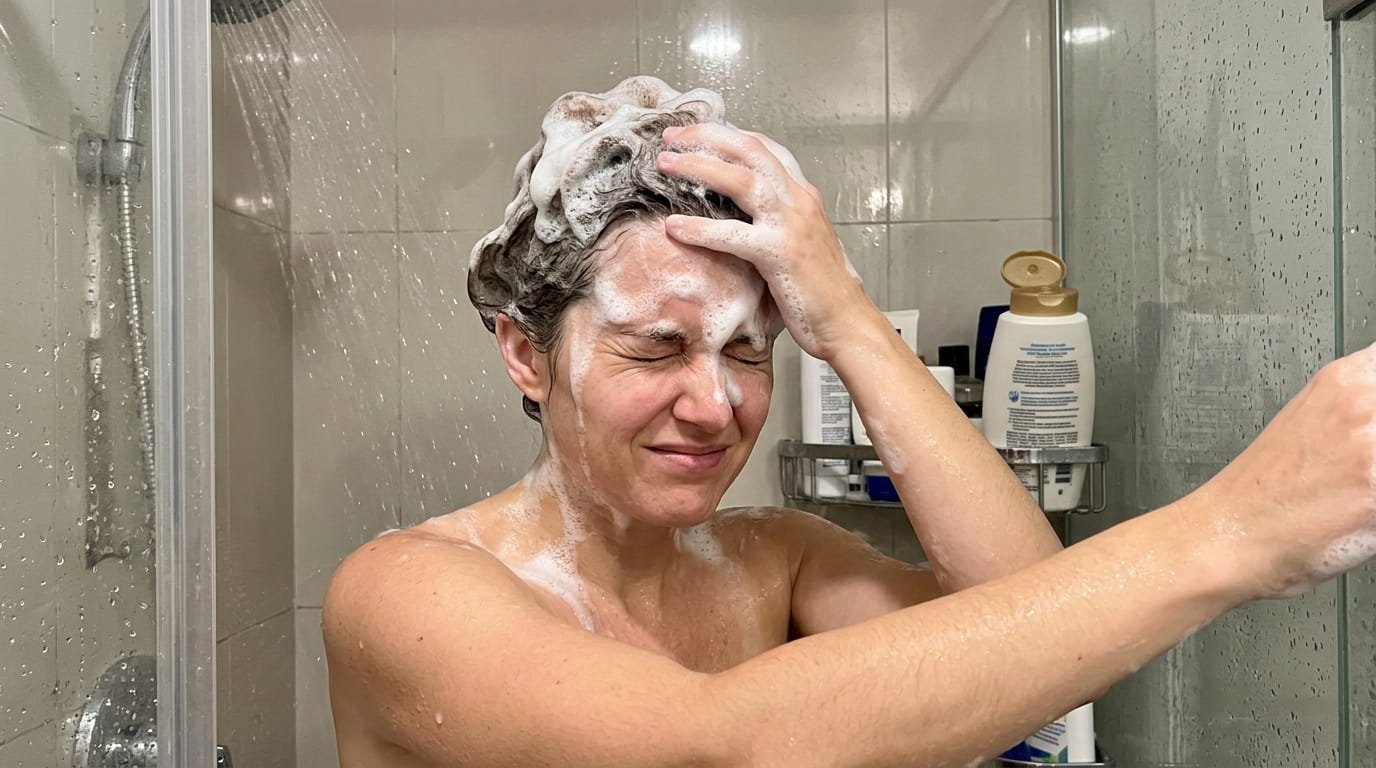
A quick back-and-forth movement across the top of your hair may create plenty of foam, but it is not necessarily giving your scalp a thorough clean.
The better approach is to use the pads of your fingertips. Massage gently but firmly across the scalp, working through different sections instead of repeatedly concentrating on one spot.
Your nails are not necessary. In fact, the focus should be on loosening oil and buildup without aggressively scratching the scalp.
A proper scalp massage also helps shampoo reach underneath thicker areas of hair. You are trying to clean the scalp, not simply make the hair look covered in bubbles.
4. Assuming More Suds Means Cleaner Hair
The amount of lather you see during your first shampoo is not always a simple measure of how clean your hair is.
When there is more oil and buildup on the hair and scalp, the first wash may produce relatively little foam. The shampoo is interacting with that oil rather than simply creating a large amount of lather.
After rinsing, a second wash may produce much more suds. That can be a useful indication that less oil is interfering with the shampoo.
This is also why a shampoo that produces huge amounts of foam immediately should not automatically be considered more effective. Foam itself is not the goal. The goal is properly cleaned hair and scalp.
5. Washing According to the Calendar
Monday and Thursday might be convenient days to wash your hair, but your hair does not know what day it is.
A fixed washing schedule can sometimes mean washing before your hair actually needs it or waiting longer than feels comfortable. Instead of choosing wash days purely because they fit your calendar, pay attention to how your scalp and hair are behaving.
The source material emphasizes that washing naturally removes some moisture from the hair. If you wash too soon, your hair may not have enough time between washes to maintain the moisture it needs.
There is no single schedule that works for everyone. The more useful approach is to respond to your hair rather than forcing it into an arbitrary routine.
6. Applying Conditioner to Wet Hair Without Removing Excess Water
Conditioner cannot work as effectively when your hair is completely saturated with water. Excess water can interfere with the conditioner making proper contact with the hair.
After rinsing your shampoo, gently squeeze the water out of your hair before applying conditioner. Avoid twisting the hair because that can contribute to tangling and breakage.
Spread the conditioner over your hands first, then work it evenly through the lengths. Make sure the inside of the hair is covered as well as the outside. Instead of measuring a fixed amount, use the feel of your hair as a guide. If parts of the length do not feel slippery and conditioned, you may need more.
Keep conditioner below the ears rather than applying it directly to the scalp. Conditioner around the roots can contribute to an oily feeling more quickly.
A Simple Way to Improve Your Washing Routine
Once you put these mistakes together, a better hair washing routine is actually quite straightforward.
Start by getting the shampoo directly to the scalp instead of concentrating on the lengths. Separate thick sections with your fingers when necessary, particularly around the back of your head. Massage the scalp using your fingertips and give the first wash enough attention to loosen oil and buildup.
If needed, wash a second time and look at the lather rather than trying to create as much foam as possible from the beginning.
After rinsing, gently squeeze excess water from the hair and apply enough conditioner to properly cover the mids and ends. Let the lengths receive the moisture they need without coating the scalp.
Finally, don’t feel that you have to wash simply because it is a particular day of the week. Your hair’s condition is a more useful guide than an arbitrary schedule.
What to Do After Washing
The routine does not have to end when you rinse out your conditioner. If your mids and ends tend to become dry after washing, a leave-in conditioner can help maintain the moisturized feeling after you leave the shower.
For additional smoothing, a small amount of hair oil can be applied to the ends once the hair is dry. Start with only a few drops and add more gradually if needed. The goal is to smooth dry or frizzy ends without making the hair look greasy.
These products work best as part of a good washing routine rather than as a way to cover up poor cleansing or excessive dryness.
The Biggest Change Is How You Wash, Not How Much You Use
A complicated hair routine is not always the answer. If your hair is constantly greasy at the roots but dry at the ends, the first thing worth examining is how you wash it.
Focus shampoo where oil is actually produced, make sure it reaches the scalp underneath thick hair, massage with your fingertips, and pay attention to how your hair responds between washes. Then use conditioner where your hair needs moisture instead of treating the scalp and ends exactly the same way.
Avoiding these common hair washing mistakes can make your existing routine more effective without requiring a bathroom full of new products.